Best Small Business KPI Dashboard Templates in 2026 (An Operator's Honest Picks)
June 8, 2026 · Craig
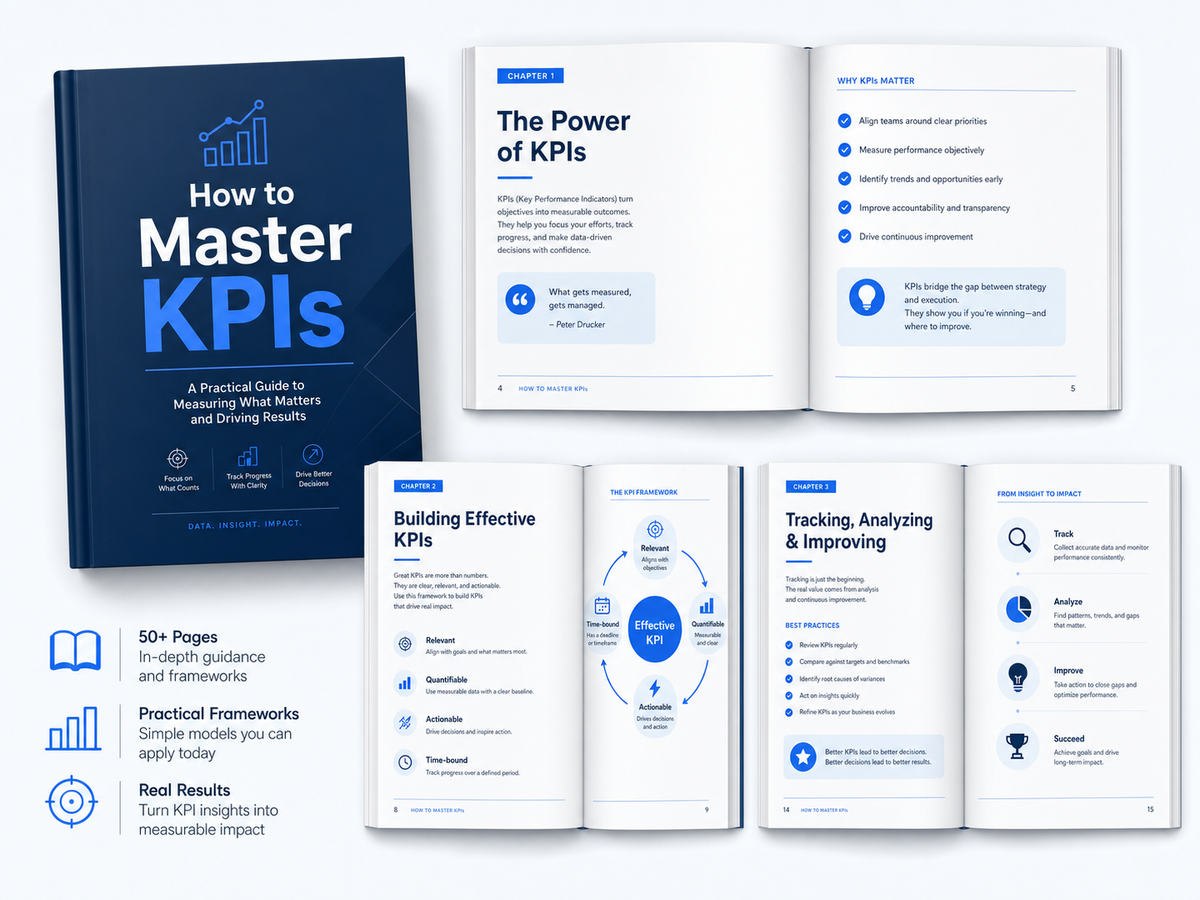
Most "best KPI template" lists are written by people who have never had to actually close a month, chase a number that didn't add up, or explain a margin drop to anyone. I've spent 20+ years supervising operations and running e-commerce, so this list is written from the chair where you actually use these things.
Here's the short version: the best KPI dashboard template is the one you'll open every week. That usually means it works in the tool you already have, doesn't lock you into a subscription, and tracks the handful of numbers that move your business — not forty vanity metrics.
What a small business KPI dashboard should actually do
Before the picks, four things separate a dashboard you'll use from one you'll abandon:
- It runs in Excel and Google Sheets. You shouldn't have to switch tools to use a template.
- It updates itself. Formulas (SUMIFS, IF, lookups) should roll your raw entries into the summary automatically. If you're hand-totaling, it's not a dashboard.
- It tracks decisions, not decoration. Revenue, average order value, refund rate, cash position, conversion — the numbers you'd actually change a decision over.
- You own the file. A one-time download you keep beats a login you rent.
The comparison
| Template | Format | Price model | Best for | Trade-off |
|---|---|---|---|---|
| Instant File Co — KPI Dashboard | Single .xlsx (Excel + Google Sheets) | One-time, no subscription | Solo operators who want a clean, formula-driven dashboard they own | Newer brand, smaller catalog |
| Vertex42 | Excel | Free | Trying a basic dashboard with zero spend | Generic; light on guidance |
| Someka | Excel + Google Sheets | One-time / bundle | Power users who want heavily designed, feature-rich dashboards | Can be more than a solo operator needs |
| Template.net | Excel, Sheets, more | Subscription | People who want sheer template volume | You're renting access, not buying a file |
| Indie Gumroad creators | Excel + Notion guides | One-time (~$10–15) | Buyers who like a creator's specific style | Quality varies creator to creator |
| Smartsheet / monday / ClickUp | SaaS platform | Free template, paid platform | Teams already living in that software | The "free template" is a doorway into a paid tool |
Free vs paid — the honest call
Free templates (Vertex42, the SaaS freebies) are genuinely fine to start. The reason operators eventually pay is rarely the spreadsheet itself — it's the time. A paid template that's already wired up, documented, and built around real decisions saves you the afternoon you'd otherwise spend building and debugging your own. If your time is worth more than ~$30 an hour, the math is obvious.
The thing to avoid is the subscription trap: paying monthly to keep access to a file. A spreadsheet is a one-time asset. Buy it once, own it forever.
Where Instant File Co fits
I built the Instant File Co KPI Dashboard to be the template I'd want on my own screen: one .xlsx that opens in Excel or Google Sheets, formulas that roll your entries into a clean summary automatically, and only the metrics that drive a decision. No subscription, no login, instant download. Operator-built, not guru-built.
It's the "Track" rung of a simple ladder — Understand → Track → Present — so if you want the KPI knowledge first or a monthly report deck after, those slot in alongside it.
FAQ
Does a KPI dashboard template work in both Excel and Google Sheets? Yes — a well-built one does. Every Instant File Co spreadsheet is a single .xlsx that works in Microsoft Excel and imports cleanly into Google Sheets, so you're not locked to one tool.
Is it a digital download? Yes. You get an instant download after purchase — there's no physical product and nothing to ship.
What KPIs should a small business actually track? Start small: revenue, average order value, refund/return rate, conversion rate, and cash on hand. Five numbers you'll review weekly beat forty you'll ignore.
Free or paid — which should I choose? Start free if you're testing the habit. Move to a paid, ready-built template once your time is worth more than the afternoon you'd spend building your own.